Wednesday, 15 May 2013

Saint Malo and some great painters (I)

St. Malo:
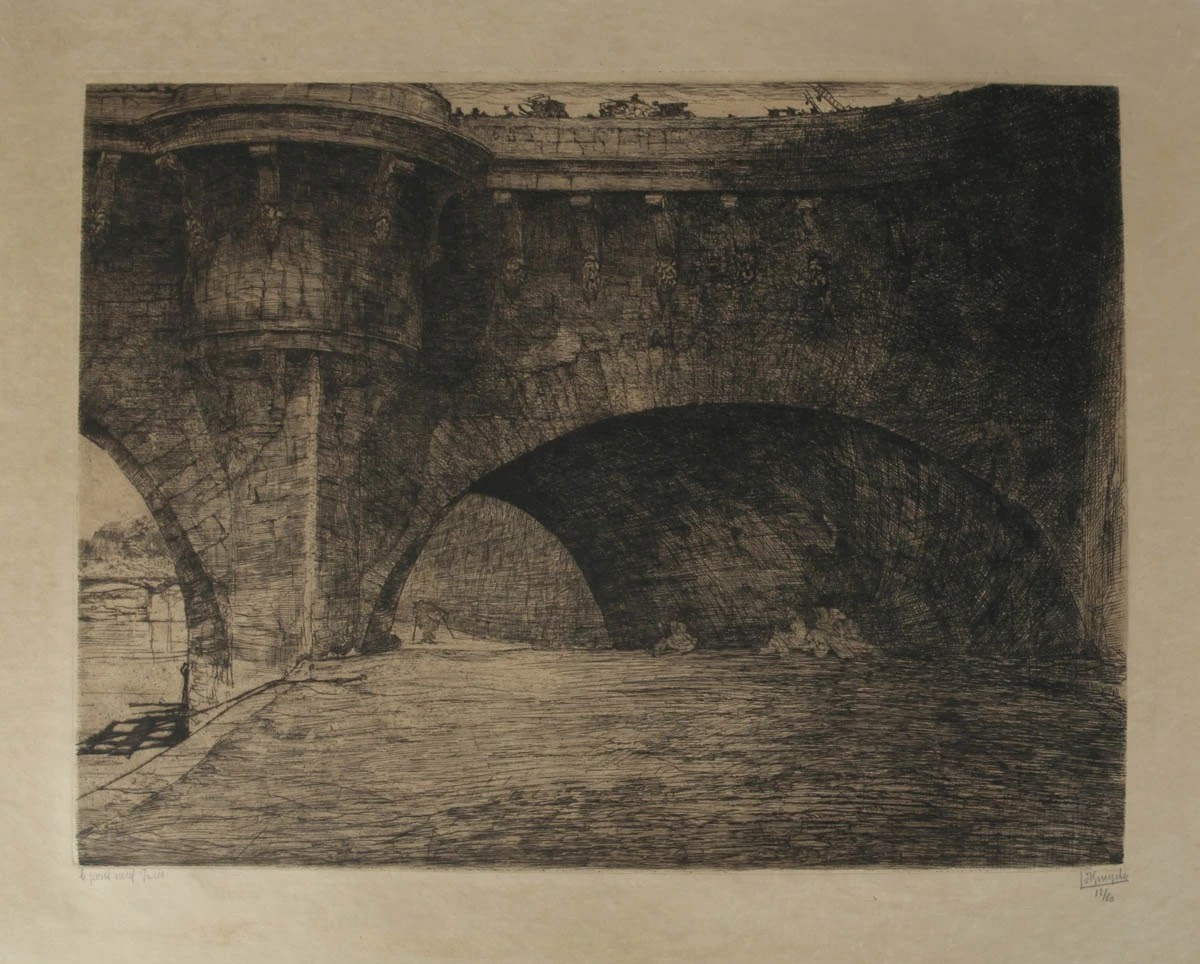
  Maurice Brazil Prendergast,  Sir Willam Russel Flint, Paul Lecomte and N. Kerber

Yes, I know, this is not a woodblock print. It's a drawing in ink. But one cannot live by prints alone. I can't, so I asked the publisher, writer and editor of this Blog to bother you today with this recent fleemarket find. It's signed N.(I think)  Kerber, 1954. I have no idea and or any clue to who he (or she) might be. This posting one day maybe helping to identify this artist. This is how St.Malo looked liked in 1954 (right in the middle of it's reconstruction 1948-1960) being the year my mother dropped me on our planet and having walked about the city in the 80's. I just couldn't leave it and had to bag it. 


Visiting St.Malo was rewarded with discovering delicious "Far Breton", one of Brittany's specialities and it's stunningly simple receipe  you'll find here* 


Saint Malo on Brittany’s NW-coast, I discovered excavating the Internet, attracted some great painters. Some famous, some less, but all trying to capture the combination of the unique walled medieval port and city, the sea and the Atlantic light.  Above around 1905, below today.
Shy American (post) impressionist Maurice Brazil Prendergast (1858-1924) was here. He visited and stayed around 1907. He met Vuillard and Bonnard and studied at the Acadamie Julian in Paris. He did many paintings of the great city and most of all of the beach and beach life in his happy, colorful and mosiac way. Many of them are described as sketches, but in fact are so good I doubt these expert qualifications. His works in oil were created later in life being    by heart a watercolor artist. 


Above: Studying these works I was amazed to discover how the artist changed his view (and witnessed the changes of the tide) from the same spot in these paintings. (High tide, Low tide, in between) A 100 years later and from my desktop ! 

And touring the Internet I discovered yet another of my favorite artists was here, William Russel Flint (1880-1964), a Scott and later knighted Sir Flint. He was definitely one of the finest masters of watercolor painting the world ever saw and he was here a few years before British and allied bombing in august 1944, freeing the French from German occupation destroyed the city almost completely in three nights of bombing.


Here Sir Flint could combine his skill's and love for the landscape with his amazing talent creating many Eves from Eden, most of them bathing with just a few hairs on brush, a dash of water and some dried pigments. He must have known St. Malo and its surrounding beaches well. Because he obviously had another great talent of being in the right place in the right time witnessing all these beached objects. And carrying a painting box around at the same time. He must have loved St.Malo because like Prendergast he made dozens of paintings of the place. His creating of water is just incredible: like Turner created skies and God created Eve. 


Paul Lecomte (1842-1920) is last in this posting on the greater gods (but who am I to judge) of (post)-impressionist painting seeing St.Malo. A contemporary of Claude Monet (1840-1926) Lecomte is considered the last painter of the Barbizon school of painting (1830-1870) freeing landscape painting from romanticism and leading it into Impressionism. Monet considered the greatest of Impressionists. Lecomte viewed St.Malo from opposite the Rance estuary  sister city Dinard (try googling: Dinard + Google Earth)  

Next: St.Malo seen by some lesser gods (but who am I to judge) of (post)-impressionist painting. 


All pictures (mouse clickable to embiggen) borrowed freely from the Internet for friendly, educational and non commercial use only.

Monday, 13 May 2013

Susanna and the Elders and some Nabis painters


Susanna and the Elders and the Nabis painters

Waiting for my request to Paris sending me a colour picture of this archived painting of Susanna and the Elders by Roland Marie Gérardin (1907-1935) shown in recent posting I today decided sharing some thematically related great paintings I’ve recently found and I really came to like. 
Susanna by Paul Ranson (1864-1909) and Paul Sérusier (1864-1927)

Just picture-Google Paul Ranson and enter a wonder world of color almost like entering into a dream or hallucination.
  
Ultimately these paintings all leading back to Paul Sérusier’s famous little painting “Talisman”. This little work, below, was to change the course of the world of painting and is said to have been painted on the back of a cigar box.

Colleague, friend and also Nabis convert ("prophet") Pierre Bonnard (1867-1947) did his best capturing the bright light in "Mimosa" according to the new theories.
  
After bringing "Talisman" back from Brittany, where Sérusier had met and worked with Paul Gauguin (1848-1903), to Paris and the Académie Julian this little marvel would upset the artistic world far beyond the mere 27 x 21 = 57 square cm. it measures. It is now in the Musee D'Orsay in Paris.
Paul Gauguin and Paul Serusier
Painting without depth (perspective) and simplifying the composition to arrangements and areas of colour it was a sensation and a true revolution. Many of these compositions could well have been designed as prints. 
Paul Ranson (1864-1909)

The group of followers naming themselves the Nabis, decided painting after Gauguins ideas of composition and colour while he later decided to continue his exotic life in the South seas. Among the groupmembers were also Maurice Denis (1870-1943) and  painter sculptor Aristide Maillol (1861-1944). 
Brittany according to Gauguin and Maurice Denis.

Painting like printmakers only Felix Valloton (1865-1925) actually produced many woodblock prints. Revolution started in Pont Aven, Brittany, France.  

His landscape paintings (above) could easily have been designed by a British or Scottish woodblock printmaker like Ian Cheyne (1895-1955) (right) and although all his prints are in black and white, Valloton basically is regarded as one of the pioneers and pivotal figures in Modern Printmaking.

Closing this Susanna posting with three more selected and more or less contemporary paintings: Susanna by influential German painter and Berlin professor Lovis Corinth (1858-1925) who, it was said, could paint a Saint just as well as a Whore and by symbolist painter Franz (von) Stuck (1863-1928). 

The last one (of this choice and selection) is by American Thomas Hart Benton (1884-1978)

All pictures are mouse clickable to embiggen and are borrowed freely from the Internet for friendly, educational and non commercial use only. 

Saturday, 11 May 2013

Hélène Mass (Maß) (VII) new finds.

The ongoing search for new pictures besides those all ready shared in the six before published postings on this artist today revealing two more new (not seen by me before) prints by printmaker Hélène Maß. Following the label attached to this posting will lead you to before postings and can be used as a reference to her prints. Or use the search function of the Blog (upper left). 
These two were offered and sold in the US in one lot a few months ago. For the purist reader: the pictures were perspectively "corrected" with Photoshop to the square (11x11 cm.) dimension she used in these small but delicate prints.
They came with American labels on the back suggesting they were originally sold in the US.  I've seen such labels before on works sold by (German) artists exhibiting in the US but haven't come across any publications mentioning such an occasion. But certainly one day ......................


Pictures borrowed freely from the Internet for friendly, educational and non commercial use only.  

Wednesday, 8 May 2013

Roland Marie Gérardin, Prix de Rome 1933


Roland Marie Gérardin
(1907-1935)
French painter

Investigating portrait artist Marthe Antoine Gérardin in before posting I couldn’ t help stumbling over her name sake Roland Marie. I have no idea if this short lived artist was in any way related to Marthe Antoine. But intrigued by the paintings emerging from the internet I noticed the consistent style and expression, the use of paint and colour in the works by this artist. So what follows here is all I was able to find about and by this obscured and forgotten artist. 
He studied at the “Ecole des Arts Decoratifs” and later at the “Ecole des Beaux Arts” in Paris under Jean-Paul Laurens (1838-1921) although this master apparently died when Gérardin was 15. During his short life however Gérardin exhibited widely and won many medals and prizes including the prestigeous French Prix de Rome in 1933 after being runner-up in 1930 and 1931 (see also below).
The pictures of the paintings I was able to find (btw: three of them are currently on offer at a French galerie and in Ebay) show a preference for outdoor groups, the reclining (sleeping) nude in an atmosphere of mild erotic leisure in many of his few paintings. The title "femme alanguies" of one of them translated into english probably closest to the emotion he tries to evoke: an expression (or posture) assuming tender sentimental melancholy.

The inspiration of Eduard Manet’s (1832-1883) composition “Dejeuner sûr l’ herbe” painted in 1862/63 and causing scandal 70 years before cannot be missed. Gérardin of course knew the iconic reclining nudes of Amadeo Modigliani (1884-1920). And there's his admiration of Peter Paul Rubens (1577-1640) his women and the arrangement of their forms in complex compositions and perspective (below: the Hermit and Angelica)   
Susanne taking a bath and watched by the two conniving dirty old men ("elders") was a theme introduced in 15th century painting giving one of two Old Testament opportunities and excuses painting the naked female body (the other being Bathsheba, king Davids wife (read here * and here* ) 
Susanne by Gérardin (I could not locate a colour version of this painting) and by Venician painter Tintoretto (1518-1594). 
For reference and future Googling readers shown together in this posting are all the paintings I could find on-line by Gérardin to this date. Gérardin was awarded an exhibition in 1989 according to this poster, in St-Ouen, a district of greater Paris, showing his pottery decorations.

    
Roland Gérardin died suddenly of some form of aggressive (pancreatic?) cancer in 1935, only 28 years old, when staying in the Villa Medici after been awarded first price in the French Prix de Rome and the grant to study at the Academy Francaise in Italy. He was burried in Bréchamp just south and not far from the Paris where he was born only 28 years before. A year later (1936) fellow 1933 Prix de Rome (music) winner Robert Planel (1908-1994) created a musical composition in his memory (read here*)

Since composing this posting took quite some unsponsored time and effort, all comments after reading are, as always, very much welcomed. Comments are the Blogwriter's fuel. I can see the number of readers increasing but leaving a notice (comment) once in a while after visiting is not a common practice. 
  ______________________________________

All pictures borrowed freely from the internet for friendly, educational and non commercial use only.